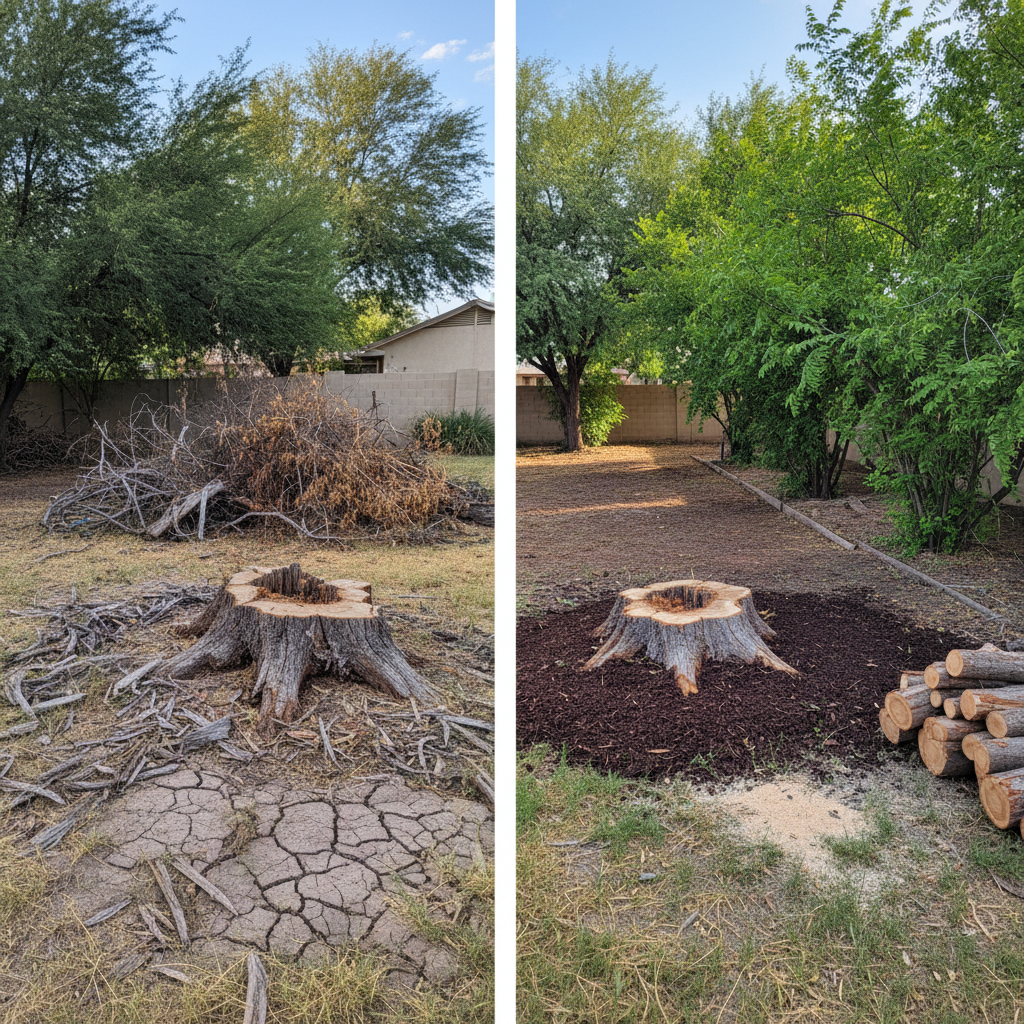
Alright, homeowners in Coolidge, let's talk about something nobody really wants to deal with, but everyone here needs to understand: emergency tree removal. You know the drill, right? A monsoon blows through, those strong winds hit hard, and suddenly you've got a tree leaning all wrong, maybe split right down the middle, or — even worse — it's already on your roof. It just happens, especially with our clay-heavy soils getting soaked and making roots less stable.
When that nightmare scenario pops up, you're looking at a decision, and it usually comes down to two main ways of handling it. I've seen folks go both routes, but one often makes a lot more sense for the long haul, especially here in Arizona.
Option 1: Just Get It Gone, Right Now
This is probably what most people picture when they hear 'emergency tree removal.' A tree's down, or it's about to be, and you just want it out of there, pronto. Sometimes, that's absolutely the right call. If a tree has crashed onto your house, your car, or is blocking an essential access point, you need it gone, and fast.
Cost:
Let's be honest: this is the most expensive way to go. Emergency service means crews drop everything, often working late at night or on weekends, and they'll bring in specialized gear like cranes for those really risky removals. I've seen emergency removal costs right here in Coolidge start around $800 for a pretty standard job, but it can easily shoot up into the thousands, especially for big trees or tricky spots. Things like the tree's size, where it is compared to buildings or power lines, and how quickly it needs to disappear all drive that price up.
Durability & Maintenance:
Once the tree's gone, well, it's gone. No durability worries for that particular tree. And maintenance? Zero, because there's nothing left. You might be left with a stump, which is a whole other service – usually stump grinding – but that's a separate cost entirely.
Appearance:
You'll end up with a big, empty spot where a tree used to be. Depending on the tree and its location, this can really change how your yard looks. If it was giving you much-needed shade, you'll definitely feel that difference immediately in our Coolidge summers. What a bummer.
When it's the right call:
- The tree has already caused serious damage to property.
- It's actively falling or leaning dangerously onto a structure or power lines.
- It's blocking emergency access or public roadways.
Option 2: Make It Safe Now, Deal with the Rest Later
This approach often gets overlooked, but it's a smart move in many situations. Instead of just ripping out the whole tree right away, we focus on making the situation safe first. That means taking off the dangerous limbs, making what's left stable, and stopping any immediate threats.
Cost:
Initially, this can actually be cheaper than a full removal. You're paying for the critical hazard work, not necessarily to get rid of the entire tree. For instance, if a big limb broke and is just hanging there precariously, we'd remove that limb safely. Then, we can check out the rest of the tree for its long-term health. It might get removed later at non-emergency rates, or, if it's possible, we can prune it and help it recover. Standard tree trimming and pruning costs are generally lower than emergency removal, after all.
Durability & Maintenance:
If the tree can be saved, you're basically investing in its future. Proper pruning after a storm can help a tree bounce back, rebalance its canopy, and make its structure stronger. This does mean ongoing maintenance, like regular trimming, but it keeps the tree as a valuable asset to your property.
Appearance:
The main goal here is to keep as much of the tree's natural beauty and shade as possible. While we might need to make some pretty big cuts at first, a skilled arborist can often shape the tree so it still looks good and keeps providing shade – which is a huge plus in Coolidge, don't you think?
When it's the right call:
- A large limb has broken, but the main trunk and structure are still sound.
- The tree is damaged but isn't an immediate threat to anyone or anything.
- You want to save the tree for its shade, how it looks, or its value to your property.
- The damage is mostly to the branches, not the main trunk or root system.
My Recommendation for Coolidge Homeowners
Look, I've been doing this a long time with Coolidge Tree Service, and I've seen firsthand what our Arizona storms can do. My recommendation, whenever we can, is to lean towards Emergency Hazard Mitigation & Phased Removal/Restoration.
Why? Because our trees, especially those mature Mesquites or Palo Verdes, are truly valuable. They give us crucial shade, help cut down energy costs, and just make your property look better. Ripping out a whole tree should really be the last thing we do. If we can make it safe now and then figure out if it can survive long-term, you'll often end up with a much better result for your yard and your wallet.
The initial emergency work will secure the area and stop any further damage. Then, we can take our time to check the tree's health, how strong it is, and if it can truly recover. Sometimes, a tree is just too far gone, and a full removal is unavoidable. But often, with the right approach, we can save it. This method also gives you more time to plan, budget, and decide what to do next without all the immediate pressure of a full-blown emergency. Plus, you avoid that big, empty spot in your yard and get to keep that valuable shade. Pretty sweet deal, if you ask me.
So, if you find yourself in a tree emergency, don't just panic and call to have the whole thing chopped down. Get a professional out there to assess the immediate danger and see if there's a smarter, more strategic way to handle it. You'll be glad you did.